Previously, my blog posts have been about different teaching styles and techniques that can be incorporated into the classroom to enhance 21st century learning. This week, I want to focus on a whole new method of teaching, as my fellow classmates and I are using this method currently to teach a lesson with- the flipped classroom method. This is a fairly new teaching method and not many teachers in the public school system use it, but it does have its many benefits.
So, what exactly is the flipped classroom method? Basically, it is a method in which the traditional style of teaching (teaching the content in the classroom and giving the application part as homework) is flipped to where content teaching is done at home and applying the content (homework) is done in the classroom. This teaching method is only possible due to the advancement of technology, in which students can watch virtual videos at home of their teacher teaching the content. While this seems unusual and unpractical, with many people pointing out the weaknesses of this teaching style, there are actually many pros and positives that can come out of this teaching method that I would like to look at.
I found a great article that lists 10 reasons flipped classrooms could change education. (http://www.edtechmagazine.com/k12/article/2015/03/cosn-2015-10-reasons-flipped-classrooms-could-change-education). This article points out the many positives flipped teaching can have on both the teachers and the students and fully embraces technology in the classroom, reflecting on the model of a 21st century teacher. I am not going address every point but I do want to look at several important benefits that I did not think about before analyzing the flipped classroom method.
One benefit that I feel is very important to the students as well as the teachers is that the flipped classroom method individualizes learning. We all know that every student learns in different ways and at different paces. By allowing the learning to take place at home, students are able to re-watch the video if they'd like, take notes, draw pictures, pause the video at times; whatever works for them and fits their learning style.
Another benefit that reflects off of individualized learning is the maximization of class-time. Since the learning is done at home, there are so many more opportunities and activities to create in the classroom for the students, such as group discussions, enriching learning experiences, critical thinking activities etc. The students already know the content so there is more time and opportunities to apply to content- which is what is important in order to produce well-rounded and engaging students! This is essential for citizens living in the 21st century.
Teachers and students also get excited to use technology for teaching purposes and this allows both the teacher and student to be more engaged in the learning process. The use of technology is simply expected, as well, in our world and generation today, as the article points out: "For students, using technology in and out of the classroom isn't just fun, it's expected, says Fulton." This means that we must fully take advantage of technology in the classroom and use it to its maximum potential, which is why the flipped method is just one way in which we can expand this technology.
The flipped classroom method should not take over the traditional teaching method. Instead, it should accompany the traditional teaching method and both methods should be used to create an engaging, diverse, and well-rounded classroom setting. I will definitely be using some flipped classroom teaching in my classroom but will also focus on traditional teaching as well. As a 21st century meaningful and purposeful instructor, we must take advantage of all the different teaching methods out there and use a variety of methods to fully prepare our students for being citizens of the 21st century.
(This method reflects teaching standard 4.d)
Wednesday, March 25, 2015

Wednesday, March 18, 2015
Literacy in the 21st Century
As we continue our focus on the 21st century educator, I want to discuss the topic of literacy this week and how the definition has changed over the past few years in regards to what makes a student or person literate in our world today. Most everyone understands the definition of literacy as being able to read and write. This is great and teachers should fulfill the duty of teaching their students proficiently how to be literate in this sense, but is this all students need to be able to do in today's world? In a world that is constantly changing, using technology in almost every aspect of life, and using new skills in the workforce?
Literacy's definition has changed because our world has changed. According to the NCTE (National Council of Teachers of English), literacy is defined as being able to be proficient in these aspects:
Gain proficiency with tools of technology
Develop relationships with others and confront and solve problems collaboratively and cross-culturally
Design and share information for global communities to meet a variety of purposes
Manage, analyze, and synthesize multiple streams of simultaneous information
Create, critique, analyze, and evaluate multimedia texts
Attend to the ethical responsibilities required by these complex environments
These aspects do not just reflect on reading and writing, which is implied in the guidelines, but also shows the expectations for successful and active citizens in the 21st century. As future teachers, we must be able to teach our students these requirements , in order to produce truly literate citizens in our world.
An article I found entitled "Deeper Learning: Twenty-First Century Literacy" takes these points listed above and expounds upon them. For example, it specifies that gaining proficiency in technology means being able to filter what is relevant information on the Internet and being able to use this skill in the workplace. It also takes the two points "Manage, analyze, and synthesize multiple streams of simultaneous information" and "Create, critique, analyze, and evaluate multimedia texts" and explains the significance of students being able to exhibit these skills: "Schools need to be preparing students to masterfully navigate, judge, and create this type of sophisticated communication -- and do so quickly and efficiently."
Literacy in our world has truly changed and is constantly changing. There are many different types of literacy today (environmental, economical, digital etc.) and many diverse types of skills associated with these literacies. What does this new definition of literacy mean for teachers in the 21st century and for the teachers' classrooms? Teachers now have a duty to fulfill in teaching students how to be literate in the 21st century, not merely teaching them how to just read and write. If teachers want to be successful, meaningful, and powerful 21st century educators, they must fulfill this task and embrace it.
Links:
http://www.ncte.org/positions/statements/21stcentdefinition
http://www.edutopia.org/blog/twenty-first-century-literacy-deeper-learning-rebecca-alber
Literacy's definition has changed because our world has changed. According to the NCTE (National Council of Teachers of English), literacy is defined as being able to be proficient in these aspects:
An article I found entitled "Deeper Learning: Twenty-First Century Literacy" takes these points listed above and expounds upon them. For example, it specifies that gaining proficiency in technology means being able to filter what is relevant information on the Internet and being able to use this skill in the workplace. It also takes the two points "Manage, analyze, and synthesize multiple streams of simultaneous information" and "Create, critique, analyze, and evaluate multimedia texts" and explains the significance of students being able to exhibit these skills: "Schools need to be preparing students to masterfully navigate, judge, and create this type of sophisticated communication -- and do so quickly and efficiently."
Literacy in our world has truly changed and is constantly changing. There are many different types of literacy today (environmental, economical, digital etc.) and many diverse types of skills associated with these literacies. What does this new definition of literacy mean for teachers in the 21st century and for the teachers' classrooms? Teachers now have a duty to fulfill in teaching students how to be literate in the 21st century, not merely teaching them how to just read and write. If teachers want to be successful, meaningful, and powerful 21st century educators, they must fulfill this task and embrace it.
Links:
http://www.ncte.org/positions/statements/21stcentdefinition
http://www.edutopia.org/blog/twenty-first-century-literacy-deeper-learning-rebecca-alber
Wednesday, March 4, 2015
TPACK- a New Form of Teaching in the 21st Century
Last week, the focus was on the SAMR model and why the SAMR model was so essential and necessary to the 21st century classroom and how it encouraged concept-based learning. This week, I want to talk about another important teaching model that highlights and captures the era we are living in today called TPACK.TPACK is very essential to all 21st century classrooms, as it uses and takes advantage of all the available resources out there in the world, and creates a model that all teachers should follow in order to be meaningful, purposeful, and powerful teachers in an engaging and student-centered classroom.
So, what exactly is TPACK? TPACK stands for technological pedagogical content knowledge and combines these three elements equally to produce an intentional and effective teaching strategy for 21st century teachers. Teachers must know and understand the content they teach, know how to teach this content, and know how to incorporate technology to support this content and these teaching practices. True and meaningful teaching occurs when a teacher uses all three aspects of TPACK: technological, pedagogical, and content.
Pedagogical and content knowledge were once the only two areas focused on by teachers. As long as teachers knew the content they taught and knew how to teach it, they were effective and purposeful teachers. However, in the 21st century this dynamic has changed due to the increase in technology, the wide availability of technology, and the many resources and opportunities that technology is now offering. We must make this shift and change in our teaching strategies and incorporate technology into our daily teaching for our benefit and for the students' benefit as well. Students in our world today constantly use technology and we must account for this by incorporating a variety of technological devices and sources.
I came across a very fascinating and thought-provoking blog that talks about the evolution in teaching strategies, in regards to TPACK. As mentioned above, content and pedagogical knowledge were the only two aspects in teaching before the 21st century. Then, at the start of the 21st century as technology became more rapid and available, we see a need for technology incorporation in the classrooms and a need for using technology to aid pedagogy. Today, things are just a bit different. With the wide, easily-assessable use of technology, we are seeing technology become part of pedagogy and seeing technology become seamless as it merges with pedagogy. As Meneghini states in the blog (link at bottom), "I will take one step further to say that technology is no longer the focus because pedagogy and technology are actually merging… More and more we see how fast changing technology is part of the world and how that impacts the ways people learn."

As we see technology becoming part of pedagogy, or in other words, seeing the way we teach being teaching through technology, it poses the question: what is the future of TPACK/ the teaching method? Meneghini suggests that: "...the supporting role of technology in learning will only grow and tend to becomes seamless." This means that technology will completely merge with pedagogy and pedagogy will be called "Pedagogy in the Digital World," creating a higher emphasis on pedagogy. Content is still in the picture, but it is not so highly focused on because content can be found and learned through the touch of a button with the empowerment of technology. Technology will become our teaching and learning in all aspects.
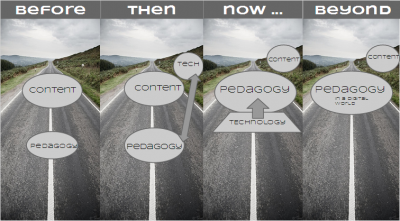 TPACK is truly a dominant and significant part of the 21st century classroom, as it requires teachers to equally use technological, pedagogical, and content knowledge in order to be meaningful, purposeful, and powerful teachers. TPACK and the SAMR model (mentioned last week) both embrace technology and use technology to its full potential, taking advantage of all the available sources technology has to offer. Technology is impacting how we teach or what strategies we use to teach the content. Truly, if we want to be successful and effective teachers, specifically concept-based social studies teachers, we will embrace and fully use the TPACK and SAMR model in our classrooms and teaching methods.
Here is the awesome blog! http://langwitches.org/blog/2013/12/10/is-technology-shoving-pedagogy-to-the-center-stage-tpack-reviewed/
So, what exactly is TPACK? TPACK stands for technological pedagogical content knowledge and combines these three elements equally to produce an intentional and effective teaching strategy for 21st century teachers. Teachers must know and understand the content they teach, know how to teach this content, and know how to incorporate technology to support this content and these teaching practices. True and meaningful teaching occurs when a teacher uses all three aspects of TPACK: technological, pedagogical, and content.
Pedagogical and content knowledge were once the only two areas focused on by teachers. As long as teachers knew the content they taught and knew how to teach it, they were effective and purposeful teachers. However, in the 21st century this dynamic has changed due to the increase in technology, the wide availability of technology, and the many resources and opportunities that technology is now offering. We must make this shift and change in our teaching strategies and incorporate technology into our daily teaching for our benefit and for the students' benefit as well. Students in our world today constantly use technology and we must account for this by incorporating a variety of technological devices and sources.
I came across a very fascinating and thought-provoking blog that talks about the evolution in teaching strategies, in regards to TPACK. As mentioned above, content and pedagogical knowledge were the only two aspects in teaching before the 21st century. Then, at the start of the 21st century as technology became more rapid and available, we see a need for technology incorporation in the classrooms and a need for using technology to aid pedagogy. Today, things are just a bit different. With the wide, easily-assessable use of technology, we are seeing technology become part of pedagogy and seeing technology become seamless as it merges with pedagogy. As Meneghini states in the blog (link at bottom), "I will take one step further to say that technology is no longer the focus because pedagogy and technology are actually merging… More and more we see how fast changing technology is part of the world and how that impacts the ways people learn."
As we see technology becoming part of pedagogy, or in other words, seeing the way we teach being teaching through technology, it poses the question: what is the future of TPACK/ the teaching method? Meneghini suggests that: "...the supporting role of technology in learning will only grow and tend to becomes seamless." This means that technology will completely merge with pedagogy and pedagogy will be called "Pedagogy in the Digital World," creating a higher emphasis on pedagogy. Content is still in the picture, but it is not so highly focused on because content can be found and learned through the touch of a button with the empowerment of technology. Technology will become our teaching and learning in all aspects.
Here is the awesome blog! http://langwitches.org/blog/2013/12/10/is-technology-shoving-pedagogy-to-the-center-stage-tpack-reviewed/
Thursday, February 26, 2015
SAMR model
To continue our look and study of what concept-based instruction is and how to create meaningful, purposeful, and powerful social studies instruction, we must look at an important element that enhances concept-based instruction and takes learning to the next level. This element is the use of technology in the classroom and how technology can deepen learning among students, not merely just scratching the surface. One model to look at to help explain this integration of technology in the classroom is the SAMR model.
The SAMR model stands for Substitution, Augmentation, Modification, and Redefinition. The SAMR model reflects the progression of technology incorporation in the classroom and how each level advances student engagement and understanding. Substitution is the lowest level of technology incorporation, while redefinition is at the highest level, reflecting deep student involvement and learning.
Now, let's take a look at each level! The first level, substitution, does not broaden or deepen student learning in any way. In other words, substitution is taking a specific task that would require pencil and paper and substituting this task for the use of computers, resulting in no fundamental change in teaching or learning. This form of learning usually reflects a teacher-centered environment, as the teacher is guiding the students' learning and tasks. An example of this would be students printing off a worksheet, filling it out, and passing it back in (https://sites.google.com/a/msad60.org/technology-is-learning/samr-model).
The next level does not broaden or transform learning either, rather enhances learning with the use of technology. This level, augmentation, takes learning to the next step by providing students with more immediate feedback and allowing for more student interaction; for example, using Google Sites/Docs that are sharable and immediate. Again, this form of learning stays within the enhancement level and is primarily teacher-centered, although it is more student-centered than substitution.
The next two levels fall within the transformation level. This is where the use of technology deepens student learning, engagement, and involvement and the original task is altered. Modification and redefinition are student-centered, as they require the students to create their own way of learning and generate the questions and discussions. An example of modification in the classroom, would be assigning the students to create an audio recording that would be played in front of an authentic audience. An audience provides students with the responsibility of producing quality work and giving them a personal stake in their work. Redefinition is taking technology to the highest level and changing the performance task while doing this. An example of redefinition is assigning groups of students the task of creating a video documentary that answers an essential question dealing with an important concept, requiring them to contact outside sources for their research. This form of learning is completely student-centered, as the students create the learning and questions and use technology to fully support their learning. https://sites.google.com/a/msad60.org/technology-is-learning/samr-model
So, why is the SAMR model so essential to concept-based learning? Concept-based learning can only be effective if it using all available resources and using these resources to deepen and broaden student learning and engagement. Scratching the mere surface with traditional classroom methods, using pencil and paper, is not using all the empowering and enhancing resources that technology allows for. By following this model as future teachers, we can progress through the process of technology incorporation in the classroom as it enhances and transforms teaching and learning. The SAMR model also reflects the NCPTS: Teachers integrate and utilize technology in the classrooms (4d), which is an important element in teaching meaningful and purposeful concept-based instruction.
The site listed at the bottom and throughout the post significantly helped me understand the SAMR model as it explained what each level meant and provided detailed examples for each level. I want to leave one quote from this site that made me ponder the significant impact the use of technology can have on the classroom through the SAMR model: "As one moves along the continuum, computer technology becomes more important in the classroom but at the same time becomes more invisibly woven into the demands of good teaching and learning." Technology does not merely support learning and teaching, it is learning and teaching.
Check out this site! A great resource! https://sites.google.com/a/msad60.org/technology-is-learning/samr-model
The SAMR model stands for Substitution, Augmentation, Modification, and Redefinition. The SAMR model reflects the progression of technology incorporation in the classroom and how each level advances student engagement and understanding. Substitution is the lowest level of technology incorporation, while redefinition is at the highest level, reflecting deep student involvement and learning.
Now, let's take a look at each level! The first level, substitution, does not broaden or deepen student learning in any way. In other words, substitution is taking a specific task that would require pencil and paper and substituting this task for the use of computers, resulting in no fundamental change in teaching or learning. This form of learning usually reflects a teacher-centered environment, as the teacher is guiding the students' learning and tasks. An example of this would be students printing off a worksheet, filling it out, and passing it back in (https://sites.google.com/a/msad60.org/technology-is-learning/samr-model).
The next level does not broaden or transform learning either, rather enhances learning with the use of technology. This level, augmentation, takes learning to the next step by providing students with more immediate feedback and allowing for more student interaction; for example, using Google Sites/Docs that are sharable and immediate. Again, this form of learning stays within the enhancement level and is primarily teacher-centered, although it is more student-centered than substitution.
The next two levels fall within the transformation level. This is where the use of technology deepens student learning, engagement, and involvement and the original task is altered. Modification and redefinition are student-centered, as they require the students to create their own way of learning and generate the questions and discussions. An example of modification in the classroom, would be assigning the students to create an audio recording that would be played in front of an authentic audience. An audience provides students with the responsibility of producing quality work and giving them a personal stake in their work. Redefinition is taking technology to the highest level and changing the performance task while doing this. An example of redefinition is assigning groups of students the task of creating a video documentary that answers an essential question dealing with an important concept, requiring them to contact outside sources for their research. This form of learning is completely student-centered, as the students create the learning and questions and use technology to fully support their learning. https://sites.google.com/a/msad60.org/technology-is-learning/samr-model
So, why is the SAMR model so essential to concept-based learning? Concept-based learning can only be effective if it using all available resources and using these resources to deepen and broaden student learning and engagement. Scratching the mere surface with traditional classroom methods, using pencil and paper, is not using all the empowering and enhancing resources that technology allows for. By following this model as future teachers, we can progress through the process of technology incorporation in the classroom as it enhances and transforms teaching and learning. The SAMR model also reflects the NCPTS: Teachers integrate and utilize technology in the classrooms (4d), which is an important element in teaching meaningful and purposeful concept-based instruction.
The site listed at the bottom and throughout the post significantly helped me understand the SAMR model as it explained what each level meant and provided detailed examples for each level. I want to leave one quote from this site that made me ponder the significant impact the use of technology can have on the classroom through the SAMR model: "As one moves along the continuum, computer technology becomes more important in the classroom but at the same time becomes more invisibly woven into the demands of good teaching and learning." Technology does not merely support learning and teaching, it is learning and teaching.
Check out this site! A great resource! https://sites.google.com/a/msad60.org/technology-is-learning/samr-model
Wednesday, February 18, 2015
Assessment OF learning, FOR learning, and AS learning
As discussed in previous blog posts, we have unraveled what it means to teach concept-based instruction. We have learned the structure of concept-based instruction, facts being on the bottom, building up to topics, concepts, and finally generalizations at the top. We focused on what a performance task is and how to create an authentic, well-developed performance task. This week, I want to explain what kind of assessment performance tasks are and what other kinds of assessments are needed to produce a clear, successful, and meaningful concept-based unit.
Performance tasks are the assessments that come at the end of the unit to check for student understanding of the material or concepts taught throughout the unit, as mentioned last week. This kind of assessment is called assessment OF learning, or could be called a summative response, and is usually formal. According to the Department of Education and Training, assessment OF learning occurs when: "...teachers use evidence of student learning to make judgments on student achievement against goals and standards." This is when the teachers reflect on how effective the learning was and if the students were able to accomplish the desired goals of the unit, showing proper understanding of the standards involved in the unit.
Performance tasks are important to check for student understanding of the unit as a whole, but is this the only kind of assessment that we need as teachers to check for student understanding. Of course not. If this was the only kind of assessment provided, we as teachers would not know if our teaching was effective during the unit, and at the end, it would be too late to go back and reteach concepts. This is why we need an assessment FOR learning, or a formative response, which could be formal or informal. The Department of Education and Training states For learning as learning that occurs when: "...teachers use inferences about student progress to inform their teaching." This kind of assessment provides timely feedback that helps students in their learning progression and allows the teacher to plan accordingly to the students' understanding of the lessons.
Assessment OF learning and FOR learning are both essential to the learning process, but another type of assessment is also important for deep, and successful learning. This kind of assessment is not focused on as highly but is still just as important. Assessment AS learning occurs when: "...students reflect on and monitor their progress to inform their future learning goals" (Department of Education and Training). This is when the students get to check for understanding on their own and reflect on how well they understand the material, setting learning goals for themselves and ways to accomplish these goals. Examples of assessment AS learning could include peer feedback (partner or group discussions) or formal self-assessment (e.g. journal logs). This type of assessment requires the students to take note of their learning progress, showing deeper and more connected learning.
As future teachers, we need to make it a priority to give assessments OF learning, FOR learning, and AS learning, in order to ensure proper concept-based learning. Each assessment is important and all three rely and depend upon each other. Check out the website I am sharing at the bottom of this page, as it is a great, interactive site that explains the three assessments, providing different activities through modules that give teachers a great resource to have! So much valuable information!
http://www.education.vic.gov.au/school/teachers/support/Pages/module4.aspx
Performance tasks are the assessments that come at the end of the unit to check for student understanding of the material or concepts taught throughout the unit, as mentioned last week. This kind of assessment is called assessment OF learning, or could be called a summative response, and is usually formal. According to the Department of Education and Training, assessment OF learning occurs when: "...teachers use evidence of student learning to make judgments on student achievement against goals and standards." This is when the teachers reflect on how effective the learning was and if the students were able to accomplish the desired goals of the unit, showing proper understanding of the standards involved in the unit.
Performance tasks are important to check for student understanding of the unit as a whole, but is this the only kind of assessment that we need as teachers to check for student understanding. Of course not. If this was the only kind of assessment provided, we as teachers would not know if our teaching was effective during the unit, and at the end, it would be too late to go back and reteach concepts. This is why we need an assessment FOR learning, or a formative response, which could be formal or informal. The Department of Education and Training states For learning as learning that occurs when: "...teachers use inferences about student progress to inform their teaching." This kind of assessment provides timely feedback that helps students in their learning progression and allows the teacher to plan accordingly to the students' understanding of the lessons.
Assessment OF learning and FOR learning are both essential to the learning process, but another type of assessment is also important for deep, and successful learning. This kind of assessment is not focused on as highly but is still just as important. Assessment AS learning occurs when: "...students reflect on and monitor their progress to inform their future learning goals" (Department of Education and Training). This is when the students get to check for understanding on their own and reflect on how well they understand the material, setting learning goals for themselves and ways to accomplish these goals. Examples of assessment AS learning could include peer feedback (partner or group discussions) or formal self-assessment (e.g. journal logs). This type of assessment requires the students to take note of their learning progress, showing deeper and more connected learning.
As future teachers, we need to make it a priority to give assessments OF learning, FOR learning, and AS learning, in order to ensure proper concept-based learning. Each assessment is important and all three rely and depend upon each other. Check out the website I am sharing at the bottom of this page, as it is a great, interactive site that explains the three assessments, providing different activities through modules that give teachers a great resource to have! So much valuable information!
http://www.education.vic.gov.au/school/teachers/support/Pages/module4.aspx
Wednesday, February 11, 2015
Performance Tasks- Following Step
Last week, I expounded on the next step in the concept-based learning process- generalizations. Generalizations consist of facts, topics, and concepts, all summed up in one simple statement, which is stated by combining two concepts. This week, we are going to take it one more step farther and add performance tasks to the concept-based process.
What exactly is a performance task and how does it relate to concept-based instruction? Performance tasks are the end assessment that show what the students have learned through the content, concepts, and generalizations taught in the unit. Performance tasks are not simply a worksheet and they are not a mere activity that focuses on one part of the unit. Performance tasks should reflect authentic learning by relating to previous learning experiences, being creative, providing clear criteria and intriguing options, and summing up all the skills, concepts and generalizations of the unit.
From the statement above, performance tasks have to be authentic. What does this mean? I have found a great, great blog that dives into what it means to create an authentic performance task and how fun it can be for students and for the teacher!(listed at the end) On this blog, the GRASPS acronym is listed which lays out all the necessities and components that are needed in creating an authentic performance task. One important part of this acronym that I would like to point out is the R which stands for the role that the students will play in the performance task. This part is where the creativity is sparked! Students can chose a role, such as an artist, journalist, or architect to take on in the performance task and let their creativity flow, producing quality and deep work.
Before we take a look at examples of authentic performance tasks, I want to share a quote from the blog I found: "We have yet to have a student not want to complete a performance task...are they easy for students? Well, we think they are challenging as the ones we design are usually cross-curricular, so students have to draw on knowledge from a variety of sources." Isn't that awesome that students are so excited and interested in performance tasks versus being bored or not wanting to complete a worksheet? Isn't it awesome that cross-curriculum can be incorporated into performance tasks versus just a worksheet on the particular topic/subject?
Now, let's take a look at some awesome, authentic performance tasks! There are so many great examples of different performance tasks that this blog has to share. One that stuck out to me was based on the standard 2nd Grade CCSS Math MD.2 and MD.4 (measuring lengths and comparing measurements), in which students had an option on whether they wanted to take on the role of a fashion designer, architect, or landscape designer. They had to draw a picture, focusing on Washington, D.C. (incorporating social studies), in which they took the measurements of different items that they drew. Here, we have a performance task that gives options, requires creativity, reflects on the standard and generalization covered, and is clear but with room for thinking outside of the box. It is an authentic performance task.
Performance tasks are essential in assessing the students' knowledge and understanding of the unit covered and allow for higher student thinking and creativity, resulting in a fun, productive learning environment. Performance tasks are also important to the concept-based learning process, as they are the completion to the concept-based unit, tying facts, topics, concepts, and generalizations learned from the unit all together.
So, check out this awesome blog and look through more great examples of performance tasks!
http://allthingsupperelementary.blogspot.com/2013/03/Authenticperformancetasks-2brainyapples.html
What exactly is a performance task and how does it relate to concept-based instruction? Performance tasks are the end assessment that show what the students have learned through the content, concepts, and generalizations taught in the unit. Performance tasks are not simply a worksheet and they are not a mere activity that focuses on one part of the unit. Performance tasks should reflect authentic learning by relating to previous learning experiences, being creative, providing clear criteria and intriguing options, and summing up all the skills, concepts and generalizations of the unit.
From the statement above, performance tasks have to be authentic. What does this mean? I have found a great, great blog that dives into what it means to create an authentic performance task and how fun it can be for students and for the teacher!(listed at the end) On this blog, the GRASPS acronym is listed which lays out all the necessities and components that are needed in creating an authentic performance task. One important part of this acronym that I would like to point out is the R which stands for the role that the students will play in the performance task. This part is where the creativity is sparked! Students can chose a role, such as an artist, journalist, or architect to take on in the performance task and let their creativity flow, producing quality and deep work.
Before we take a look at examples of authentic performance tasks, I want to share a quote from the blog I found: "We have yet to have a student not want to complete a performance task...are they easy for students? Well, we think they are challenging as the ones we design are usually cross-curricular, so students have to draw on knowledge from a variety of sources." Isn't that awesome that students are so excited and interested in performance tasks versus being bored or not wanting to complete a worksheet? Isn't it awesome that cross-curriculum can be incorporated into performance tasks versus just a worksheet on the particular topic/subject?
Now, let's take a look at some awesome, authentic performance tasks! There are so many great examples of different performance tasks that this blog has to share. One that stuck out to me was based on the standard 2nd Grade CCSS Math MD.2 and MD.4 (measuring lengths and comparing measurements), in which students had an option on whether they wanted to take on the role of a fashion designer, architect, or landscape designer. They had to draw a picture, focusing on Washington, D.C. (incorporating social studies), in which they took the measurements of different items that they drew. Here, we have a performance task that gives options, requires creativity, reflects on the standard and generalization covered, and is clear but with room for thinking outside of the box. It is an authentic performance task.
Performance tasks are essential in assessing the students' knowledge and understanding of the unit covered and allow for higher student thinking and creativity, resulting in a fun, productive learning environment. Performance tasks are also important to the concept-based learning process, as they are the completion to the concept-based unit, tying facts, topics, concepts, and generalizations learned from the unit all together.
So, check out this awesome blog and look through more great examples of performance tasks!
http://allthingsupperelementary.blogspot.com/2013/03/Authenticperformancetasks-2brainyapples.html
Wednesday, February 4, 2015
Generalizations- Next Step
I talked thoroughly about concept-based instruction in my last post and emphasized the importance of teaching concept-based instruction, rather than traditional fact-based instruction, because of the deeper and more intellect thinking that concept-based instruction produces. This week, I want to focus on the next step in developing concept-based instruction and how this next step is essential in producing meaningful and purposeful social studies curriculum.
Once concepts are developed in a social studies unit, generalizations are to be formed and learned. What is a generalization? A generalization consists of two or more concepts tied together to produce a statement that connects the concepts, while providing a qualifier. A qualifier being a statement such as: most of the time, often, or can be. Generalizations are seen to be the "roof "or finishing component of the building blocks of concept-based instruction, resting upon the facts, topics, and concepts.
So, why are generalizations so important and essential to concept-based instruction? Generalizations sum up the facts, topics, and concepts into one complete statement. Generalizations produce the highest level of thinking, and if our students can reach that level, we have done our job as teachers. According to the Unit Development Process by the Public Schools of North Carolina, our highest goal as teachers should be that the students can derive the generalization on their own: "Your ultimate goal should be to have your students derive the generalizations naturally, based on the content and concepts that you have selected as the core of your instructional conceptual unit." If our students can do this, we have accomplished our goal as meaningful and powerful social studies teachers.
Generalizations are not easy to develop. It takes time, thought, and practice to develop an understandable and complete generalization. The site that I will list at the bottom of the blog is great in understanding how to develop generalizations and it takes you step-by-step through the process. Basically, the main guidelines in producing your generalization are using present tense (timeless), showing a transferable relationship between the concepts, and using a qualifier. With these guidelines, a well-developed and profound generalization can be formed.
Concept-based instruction is not complete without the "roof"- generalization. As future teachers, we cannot just stop at the facts, topics, or even concepts. We must sum up all three of these components and help the students understand the meaning and "big idea" of the unit. If our students can form the generalization on their own, then we are going above and beyond as teachers and accomplishing our goal. Meaningful, purposeful, and powerful education is not complete without generalizations!
Link to helpful website: http://cbci.ncdpi.wikispaces.net/Generalizations.
Once concepts are developed in a social studies unit, generalizations are to be formed and learned. What is a generalization? A generalization consists of two or more concepts tied together to produce a statement that connects the concepts, while providing a qualifier. A qualifier being a statement such as: most of the time, often, or can be. Generalizations are seen to be the "roof "or finishing component of the building blocks of concept-based instruction, resting upon the facts, topics, and concepts.
So, why are generalizations so important and essential to concept-based instruction? Generalizations sum up the facts, topics, and concepts into one complete statement. Generalizations produce the highest level of thinking, and if our students can reach that level, we have done our job as teachers. According to the Unit Development Process by the Public Schools of North Carolina, our highest goal as teachers should be that the students can derive the generalization on their own: "Your ultimate goal should be to have your students derive the generalizations naturally, based on the content and concepts that you have selected as the core of your instructional conceptual unit." If our students can do this, we have accomplished our goal as meaningful and powerful social studies teachers.
Generalizations are not easy to develop. It takes time, thought, and practice to develop an understandable and complete generalization. The site that I will list at the bottom of the blog is great in understanding how to develop generalizations and it takes you step-by-step through the process. Basically, the main guidelines in producing your generalization are using present tense (timeless), showing a transferable relationship between the concepts, and using a qualifier. With these guidelines, a well-developed and profound generalization can be formed.
Concept-based instruction is not complete without the "roof"- generalization. As future teachers, we cannot just stop at the facts, topics, or even concepts. We must sum up all three of these components and help the students understand the meaning and "big idea" of the unit. If our students can form the generalization on their own, then we are going above and beyond as teachers and accomplishing our goal. Meaningful, purposeful, and powerful education is not complete without generalizations!
Link to helpful website: http://cbci.ncdpi.wikispaces.net/Generalizations.
Subscribe to:
Posts (Atom)